

Market Psychology: How to Master Your Emotions and Avoid Emotional Trading
Updated: Sep 25
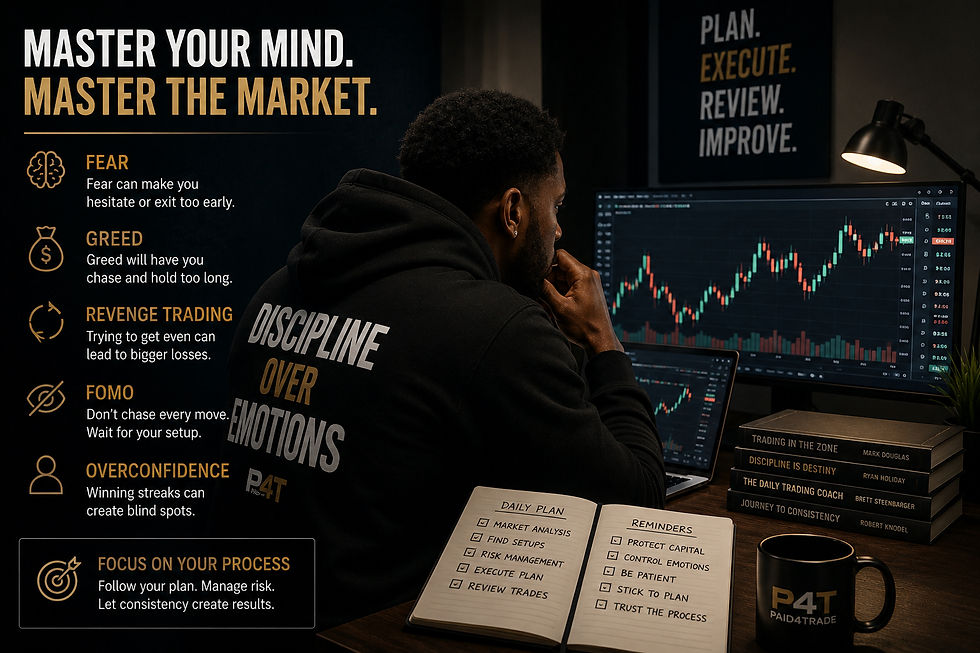
Trading is not just about charts, indicators, entries, and exits. One of the biggest battles a trader faces happens inside their own mind.
You can have a great strategy, understand support and resistance, identify trends, and still lose money because of fear, greed, impatience, revenge, or overconfidence.
This is why market psychology is one of the most important parts of becoming a consistently disciplined trader.
The goal isn't to eliminate emotions. That's impossible. The goal is to learn how to recognize your emotions without allowing them to control your decisions.
What Is Market Psychology?
Market psychology is the study of how emotions and behaviors influence trading decisions and, collectively, how those decisions influence the market.
Markets are made up of people and institutions making decisions based on information, expectations, fear, confidence, and risk. When traders become extremely optimistic, buying pressure can increase. When fear takes over, traders may rush to sell.
For an individual trader, understanding psychology means understanding how the market behaves because of collective emotions and how your own emotions affect your trading decisions.
The Five Biggest Emotional Trading Problems
1. Fear
Fear can cause traders to exit profitable trades too early, avoid good setups, move stop-losses, or hesitate when their strategy gives them an entry.
How to control fear: instead of asking, “What if I lose?” ask, “Did this trade meet my rules?” A losing trade doesn't automatically mean you made a bad decision, and a winning trade doesn't automatically mean you made a good decision. Judge the process, not just the outcome.
2. Greed
Greed often appears after a trader starts winning. You make a profit, then start holding longer, increasing size, or taking additional trades because you want more.
How to control greed: before entering a trade, determine the entry, stop-loss, take-profit, risk amount, risk-to-reward ratio, and conditions that would invalidate the setup. A trade isn't successful because it makes the most money possible. A trade is successful when you executed your plan correctly.
3. Revenge Trading
Revenge trading happens when a trader takes another trade specifically because they are angry about a previous loss. A small loss can quickly turn into a major drawdown when the trader keeps trying to get the money back immediately.
How to stop revenge trading: after a significant loss, step away from the charts and reset. Never let the market become something you are trying to beat. Your next trade should be based on a setup, not on your previous trade.
4. FOMO — Fear of Missing Out
You see an instrument suddenly move and feel like you have to get in before it goes further. This often leads to entering after the move has already happened, without a planned setup.
Remember: you do not have to catch every move. There will always be another setup. Missing a trade is not the same thing as losing money. If you missed your entry, wait for your strategy to provide another opportunity.
5. Overconfidence
Winning can create emotional trading too. After several profitable trades, a trader may start believing they can't lose, increase position size, stop using proper risk management, or enter setups that don't meet their criteria.
How to control overconfidence: treat every trade as an individual opportunity. A winning streak does not guarantee another win, and a losing streak does not guarantee another loss. Your strategy still needs to be followed regardless of what happened previously.
The Difference Between a Good Trade and a Winning Trade
A winning trade is a trade that makes money. A good trade is a trade that followed your plan. Those aren't always the same thing.
You can't control the market's outcome. You can control your execution.
Build a Trading Plan Before You Trade
One of the best ways to reduce emotional decisions is to make decisions before your emotions become involved.
Your trading plan should define your entry conditions, stop-loss, take-profit, acceptable risk, timeframes, maximum trades, and daily loss limit.
Stop Watching Your P&L Every Second
Constantly watching profit and loss can make your emotions change with every tick. Focus on the chart and your predetermined levels instead. Ask: Has my setup changed? If not, there may be no reason to interfere with the trade.
Accept That Losses Are Part of Trading
No strategy wins every trade. The goal isn't to avoid every loss. The goal is to keep losses controlled and let your strategy play out over a sufficiently large sample of trades.
Think in probabilities. If your strategy risks a defined amount for a larger potential reward, you don't need to win every trade to have a chance of being profitable. Consistency matters more than perfection.
Don't Risk Money You Can't Afford to Lose
Emotional trading becomes more likely when a trader desperately needs a trade to win. If losing the amount you're risking would affect essential expenses, that risk level is too high. Trading capital should be money you can genuinely afford to lose.
Create a Pre-Trade Checklist
Before entering, check your market conditions, setup, entry, stop, target, and risk-to-reward. Then check your psychology: Am I entering because of FOMO? Am I trying to recover a previous loss? Am I angry? Am I overly confident? Am I increasing risk because I recently won?
Keep a Trading Journal
A trading journal should record more than entries and exits. Record why you entered, your setup, your risk, your emotions, whether you moved your stop, whether you closed early, whether you revenge traded, and what you would do differently next time.
The 3-Second Rule
Before clicking Buy or Sell, pause and take a breath. Ask yourself: Would I still take this trade if I couldn't see my current profit or loss? If the answer is no, your decision may be emotionally driven.
Develop Patience
Professional trading isn't about constantly being in a position. Sometimes the best thing you can do is wait. If your strategy requires specific conditions, wait for those conditions. No setup equals no trade.
Think in Probabilities, Not Certainties
Nobody knows with certainty what the next candle will do. Instead of thinking that an instrument is definitely going up or down, think in terms of probabilities and predefined risk. That mindset helps you manage uncertainty instead of trying to predict the future perfectly.
Your Goal Should Be Consistency
Many traders ask how much money they can make today. A better question is how well they can execute their strategy today. Money is the result. Discipline is the process.
The Trader's Mindset
I don't need to win every trade. I don't need to catch every move. I don't need to trade every day. I don't need to recover a loss immediately. I don't need to prove myself to the market. I only need to follow my plan and manage my risk.
Final Thoughts
Market psychology is not something you master overnight. The objective isn't to become emotionless. The objective is to become disciplined enough that your emotions don't dictate your actions.
Plan the trade. Define the risk. Wait for the setup. Execute without hesitation. Accept the outcome. Learn from the result. Then do it again.
The market will always be there tomorrow. Your job isn't to catch every opportunity. Your job is to protect your capital, follow your system, and become a better trader one decision at a time.
Profit Empire
Trade with purpose. Trade with discipline. Build for the long term.
Comments